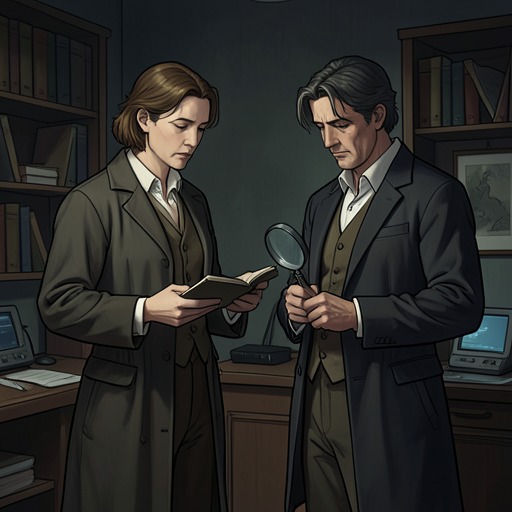
Mark Easterbrook and Ginger Corrigan
The Pale HorseMark Easterbrook and Ginger Corrigan’s relationship develops from investigative partnership into a romantic commitment, with danger and shared moral purpose drawing them closer. Ginger’s willingness to impersonate Mark’s wife first turns their cooperation into a strikingly intimate performance; later, her insistence that their work is no longer a game gives the partnership ethical weight. When she falls ill, Mark’s immediate decision to go to her makes that attachment personal and urgent. The relationship ends with a proposal, though the evidence stops at the offer rather than confirming a marriage.
From Investigators to Pretend Spouses
The relationship’s first explicit domestic gesture is also a piece of investigative planning. Mark worries that a fictitious wife will require details, including where she lives, and that he will be unable to answer convincingly. Ginger counters that the plan will work only if the wife is actually present, then reveals that she will take the role herself. Her announcement transforms a problem of maintaining a cover story into a shared act: she is not merely supplying information but stepping into the identity the investigation requires.
Mark’s response is astonishment. He stares at her, unable to take in the proposal at once, and reflects that she might have burst out laughing. The moment gives their collaboration a playful edge, but it also shows Ginger’s confidence in their ability to act together. The wife role is initially assumed for practical reasons, not offered as a declaration of romantic commitment. Its significance lies in how readily Ginger makes herself part of Mark’s plan, and in how the performance brings them into a more intimate form of cooperation.
Shared Purpose and Moral Seriousness
That cooperation becomes more consequential when Mark acknowledges that he was the one who brought Ginger into the affair. Ginger accepts that he may have introduced her to it, but rejects the importance of deciding who came first: they are both involved now, and both have to act. Her response marks a change in tone. She insists that she is serious and that the matter is not simply entertaining; if their suspicions are correct, the organization they are investigating must be stopped.
Ginger distinguishes this killing from murder driven by immediate passions such as hatred or jealousy, and even from murder for personal gain, where the killer takes the risk. What alarms her is murder conducted as a business, without regard for the identity or character of the victim. Her words make the investigation a shared moral responsibility rather than an adventure undertaken for curiosity. She still allows for doubt about whether their interpretation is true, but that qualification does not diminish her resolve to act if it is. The partnership therefore rests on both practical cooperation and a deliberately chosen obligation to prevent further deaths.
Danger, Apprehension, and Care
During the séance at the Pale Horse, Mark remains outwardly critical of the staged atmosphere. He recognizes the funeral march as part of the scene-setting and dismisses its trappings, yet notices an unwanted undercurrent of apprehension in himself. That contrast gives the investigation a personal dimension: skepticism does not make the danger feel unreal. The passage does not present Ginger as sharing this particular reaction, but the apprehension belongs to the perilous inquiry in which they have joined forces.
The relationship becomes more directly intimate when Ginger is ill. Mark reassures her and tells her he is coming to her at once, despite her protest. Ginger agrees that she is glad he is coming and admits that she may not be as brave as she had thought. The exchange shifts their connection from common purpose to mutual vulnerability: Mark responds with immediate care, while Ginger lets him see her fear rather than sustaining the confidence she had claimed. Her illness is not simply another obstacle in the investigation; it gives their attachment a personal stake and makes Mark’s presence matter to her.
Proposal and Unresolved Future
Near the end, the conversation turns to marriage through an indirect, lightly teasing exchange. After Mark tells Ginger that she will make a good mother, she blushes. He asks whether she will, and she pretends to misunderstand him before saying that she would prefer a firm offer. Mark makes one. The movement from teasing to a direct commitment gives the relationship its clearest resolution: the alliance that began with Ginger volunteering to act as his wife ends with Mark offering marriage in earnest.
Ginger then asks whether Mark is quite sure he does not want to marry Hermia Redcliffe. The question brings Mark’s possible attachment to Hermia into the proposal scene, but does not establish what he felt for her or supply a detailed account of that relationship. What it does establish is that Ginger asks for certainty at the moment commitment is offered. Her request for a firm offer and her question about Hermia make the ending more than a convenient romantic conclusion: the proposal must answer a concern she raises openly. The text confirms Mark’s offer and Ginger’s question, but does not go on to confirm that they marry.